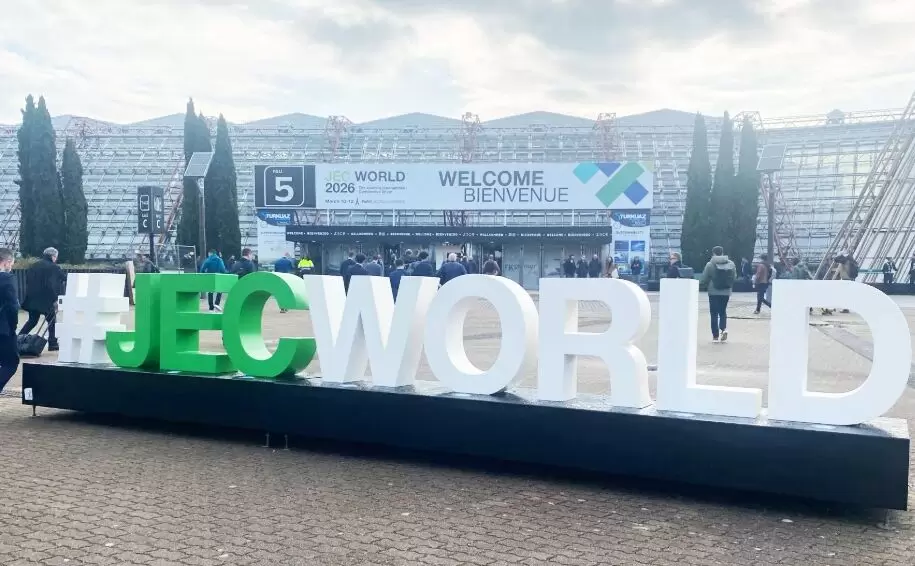
Thermoplastic welding, thermoplastic UD tapes at scale, and FGF (LFAM) 3D printing dominated the first day at JEC World 2026. Here’s a concise snapshot of what stood out.
1. Thermoplastic welding: clear momentum
Welding of thermoplastic composites was one of the hottest themes on the floor. Aerospace and automotive both showed serious progress.
Aerospace — Daher + LIST award-winning wing rib. The standout was Daher’s CFRTP wing rib for Airbus’ Wing of Tomorrow, developed with LIST (Luxembourg Institute of Science and Technology) and recognised as an award-winning project. It is a primary structural element (aerodynamic shape, stiffness, load transfer) with up to 64 plies (~12 mm thickness) — well beyond “thin” thermoplastic parts — and is aimed at industrial production rates, with optimisation for cost, mass, and carbon footprint. The enabling innovations: optimised design (ply drops, reduced joining surfaces, simplified stiffener geometry); Direct Stamping® (Daher’s patented route that removes the intermediate consolidation step between lay-up and stamping, cutting cycle time and cost); and infrared welding (LIST’s patented process) for rapid assembly of sub-components into a T-shaped rib without fasteners, reducing weight further.
Aerospace — NLR and the Multifunctional Fuselage Demonstrator. NLR demonstrated induction and resistance welding: welded stiffeners and a welded fuselage section. In the Multifunctional Fuselage Demonstrator (MFFD)programme, several welding techniques and use cases have been developed — conduction, ultrasonic, and resistance welding for stringers, frames, and clips — illustrating how thermoplastic welding is moving toward production readiness for large fuselage structures
Automotive — Fraunhofer IWS showed interface tailoring through adaptive laser processing for thermoplastic welding: highest adhesion strength, maximum material and design flexibility, no adhesive promoters, and improved separability at end-of-life. IWS demonstrated a thermoplastic fiberglass beam with welded aluminium and thermoplastic components after adaptive laser processing — a clear signal that welding is not only for all-composite parts but also for hybrid metal–thermoplastic assemblies in automotive.
2. Thermoplastic UD tapes: scaling across the supply chain
Thermoplastic UD tapes were visible at almost every major materials stand. Toray, Mitsubishi Chemical, Hexcel, and other established players presented thermoplastic product lines, including UD tapes, reinforcing the shift from “niche” to standard offering. Chinese suppliers – Junhua PEEK, Hengbo, H-Poly gained noticeable visibility in thermoplastic materials, though they are still under-represented compared with the incumbents. The overall picture: thermoplastic UD tapes are no longer a curiosity but a scaling product category with a broadening supplier base.
3. FGF 3D printing: molds, hybrids, and the retreat of CCF
FGF (fiber-reinforced pellet / short-fiber) 3D printing was hard to miss — “almost in every corner.” Continuous carbon fiber (CCF) 3D printing, by contrast, was much less prominent, almost absent. The main traction was in two directions: rapid manufacture of composite molds (LFAM-style FGF for large tools) and hybrid AFP–FGF sandwich panels. A striking example was Elecreoimpact’s hybrid panel: complex 3D-printed infill with laser AFP skins — a clear step toward structural sandwich parts that combine printed core geometry with placed continuous fiber skins.
Takeaway
On day one, JEC World 2026 underlined three trends: thermoplastic welding moving from R&D into aerospace and automotive demonstrators and production intent (Daher/LIST rib, NLR/MFFD, Fraunhofer IWS/FWS); thermoplastic UD tapes scaling across global materials suppliers; and FGF 3D printing dominating the additive-composites narrative, with LFAM for molds and hybrid AFP–FGF structures as the emerging applications. Thermoplastics and welding are no longer side topics — they are central to how the industry is talking about the next generation of composite manufacturing.


 Location :


 中
中
 En
En